

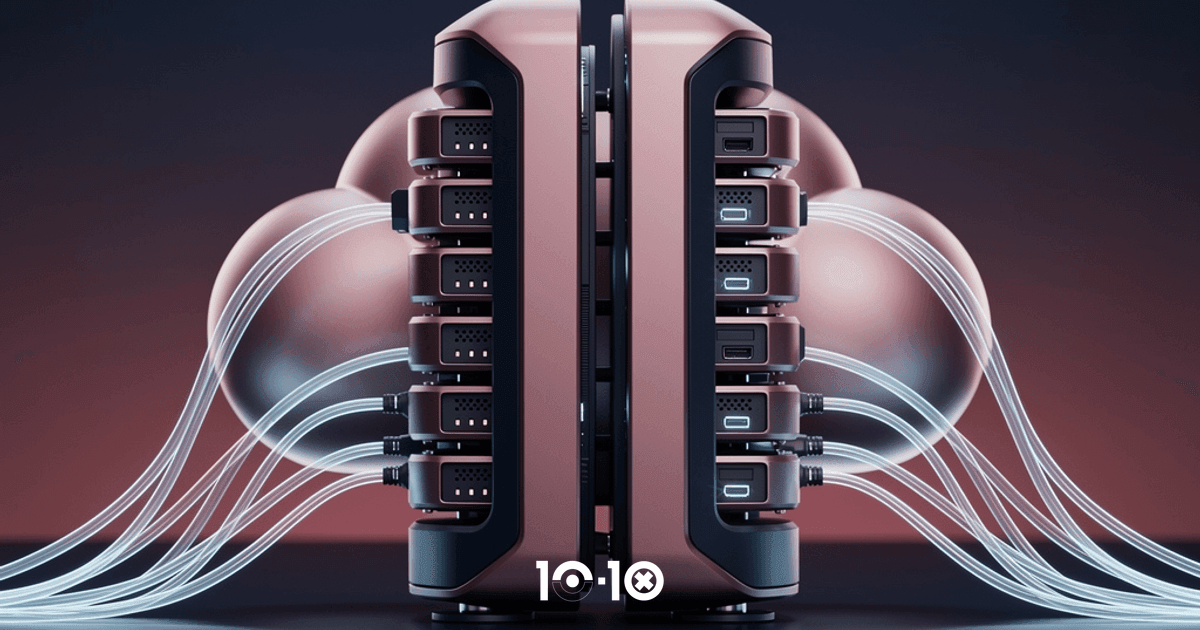
Hybrid cloud for business: what the Compass and HeyLight case teaches European SMBs
Hybrid cloud has moved from a technical buzzword to a practical strategy that European businesses use every day to stay competitive. The recent modernisation of Compass, the Italian consumer credit company part of the Mediobanca Group, offers a concrete example of how a hybrid cloud for business can combine the reliability of traditional systems with the agility of modern cloud platforms. Through its HeyLight ecosystem, Compass renewed its financial infrastructure without throwing away the legacy systems that had served it for decades. For small and medium enterprises across Italy and the wider European Union, this story holds lessons that go well beyond the banking sector.
The core idea is simple. Instead of choosing between on-premise infrastructure and public cloud, a hybrid model lets you run both at once, placing each workload where it makes the most sense. Sensitive customer data and mission-critical banking systems can stay on controlled, private infrastructure, while customer-facing apps and services that need to scale quickly live in the cloud. This balance is exactly what makes hybrid cloud for SMEs so attractive right now.
Why Compass chose a hybrid path
Compass did not start from a blank page. Like most established companies, it had years of investment tied up in core banking systems, databases, and internal processes that could not simply be switched off. These legacy systems were stable and trusted, but they lacked the flexibility to support new digital products and the demands of a mobile-first market.
The HeyLight ecosystem was designed to bridge that gap. Rather than a costly and risky “big bang” migration, Compass connected its traditional infrastructure to cloud services, allowing the two worlds to work together. The result is an app and a set of digital services that can grow, update, and respond to customer needs quickly, all while the underlying financial engine keeps running on proven, secure foundations.
This measured approach matters. Financial services are among the most heavily regulated sectors in Europe, and a full replacement of core systems would have introduced enormous operational risk. Hybrid cloud let Compass modernise the customer experience while protecting the parts of the business that simply cannot fail.
Hybrid cloud for SMEs: practical lessons from a large-scale project
You might reasonably ask what a Mediobanca Group company has to do with a 20-person firm in Milan or a family-run manufacturer in the Veneto. The answer is that the underlying challenge is identical, just at a different scale. Almost every established SME runs on a mix of older software, on-premise servers, and a few cloud tools that were added over time without a clear plan.
The pressure to modernise is real and growing. According to Eurostat, around 45% of EU enterprises purchased cloud computing services in 2023, up sharply from previous years, with adoption still uneven across smaller firms. Meanwhile, market analysts consistently report that the majority of organisations now describe their IT setup as hybrid rather than purely on-premise or purely cloud. The direction of travel is clear, and the businesses that plan for it deliberately tend to spend less and disrupt less than those forced into reactive changes.
Here is where the Compass example becomes genuinely useful for smaller companies:
You do not have to replace everything at once
The biggest fear around cloud migration and IT infrastructure change is downtime and cost. A hybrid model removes much of that fear. You can move one workload at a time, keep your critical systems untouched until you are ready, and validate each step before moving on. This staged approach is far more realistic for an SME budget than a single, expensive overhaul.
If your business is weighing up this kind of transition, our cloud migration services are built around exactly this principle: modernise progressively, protect what already works, and only move what genuinely benefits from the cloud.
Legacy systems can be an asset, not just a burden
There is a common myth that older systems must be scrapped to be modern. The Compass case shows the opposite. Legacy system modernisation is often about connecting, extending, and gradually improving what you already have, rather than replacing it wholesale. A well-integrated legacy system can continue delivering value for years while cloud services handle the parts that need speed and scale.
For many European SMEs, this is reassuring. The knowledge embedded in your existing tools, from your ERP to your custom internal software, does not have to be lost. With the right IT infrastructure design, those systems can become the stable core of a modern, flexible environment.
Security and compliance in a hybrid environment
For any business operating in the EU, security and regulatory compliance are not optional extras. The GDPR, the NIS2 Directive, and sector-specific rules such as DORA for financial entities all shape how data must be stored, processed, and protected. A hybrid cloud for business gives you a practical way to meet these obligations.
The key advantage is control over data placement. Personal and sensitive information can remain within your own infrastructure or within EU-based cloud regions, addressing data sovereignty concerns that many Italian and European businesses take seriously. Less sensitive workloads can then use the wider capabilities of public cloud without compromising your compliance position.
That said, a hybrid setup does introduce a broader attack surface, because you are now securing both on-premise and cloud environments plus the connections between them. This is why data protection cannot be an afterthought. Reliable backup and disaster recovery, ideally following the well-known 3-2-1 rule, become essential in a distributed environment where data lives in more than one place.
Strong endpoint protection, identity management, and continuous monitoring should sit alongside your infrastructure plans from day one. You can explore our cybersecurity services to see how these layers fit together, and our partnership with specialists such as Acronis supports resilient backup and recovery across hybrid setups.
Managing complexity without a large IT team
One honest concern for smaller businesses is complexity. A hybrid environment has more moving parts than a single server room or a single cloud account, and most SMEs do not have a large internal IT department to manage it. This is a valid point, and it should shape how you approach the project.
The realistic answer is a mix of good design and the right support. A hybrid architecture that is well planned from the start, with clear standards, automation, and centralised monitoring, is far easier to run than one that grows piece by piece. Where internal skills are limited, a trusted managed services partner can handle day-to-day operations, freeing your team to focus on the business itself.
What European SMBs should take away
The Compass and HeyLight case is not really a story about banking technology. It is a story about how established organisations can evolve without gambling their operations on a single risky change. That lesson scales down neatly to businesses of every size across Italy and Europe.
The practical takeaways are straightforward. First, hybrid cloud lets you modernise at a pace your business can absorb, both financially and operationally. Second, legacy systems deserve to be integrated thoughtfully rather than discarded, because they still hold real value. Third, security and EU compliance should guide every decision, not follow after the fact.
For SMEs, the message is encouraging. You do not need the budget of a Mediobanca Group company to benefit from these principles. With a clear plan, a staged approach to cloud migration and IT infrastructure, and a focus on protecting what matters, a hybrid cloud strategy can make your business more flexible, more resilient, and better prepared for whatever comes next.